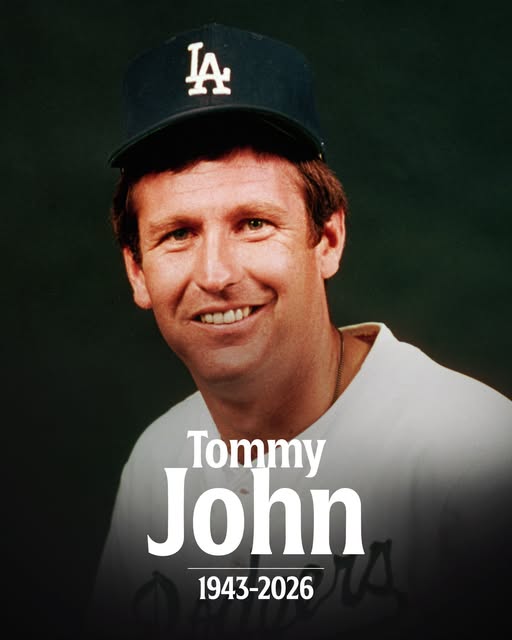
Tommy John built a baseball career defined by perseverance, skill and extraordinary longevity, but his greatest legacy extended far beyond the pitching mound. The four-time All-Star, whose name became synonymous with one of sports medicine’s most transformative procedures, has died at 83. He died Saturday at his home in Bradenton, Florida, after spending time in hospice care.
John spent 26 seasons in Major League Baseball, beginning with Cleveland in 1963 and making his final appearance with the New York Yankees in 1989. He also pitched for the Chicago White Sox, Los Angeles Dodgers, California Angels and Oakland Athletics. He finished with 288 victories, 2,245 strikeouts and 700 starts, while appearing in four All-Star Games and helping anchor three pennant-winning teams.
His career changed dramatically in 1974 when he suffered a serious elbow injury. Dr. Frank Jobe performed an experimental ulnar collateral ligament reconstruction, allowing John to return to baseball in 1976. He subsequently pitched for another 14 seasons, proving that the procedure could give injured athletes another chance. The operation became widely known as “Tommy John surgery” and went on to transform sports medicine.
The Yankees remembered John as more than an accomplished pitcher, praising his competitiveness, kindness, gracious nature and influence as an athletic and medical pioneer. He is survived by his wife, Cheryl, and children Tamara, Tommy III and Travis; the Yankees also remembered his late son Taylor.
Tommy John leaves behind a legacy measured not only in wins, but in the countless athletes whose careers became possible because he helped prove that recovery could lead to another beginning.